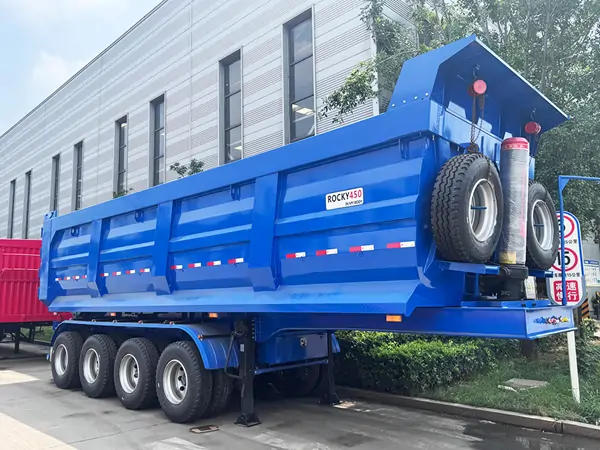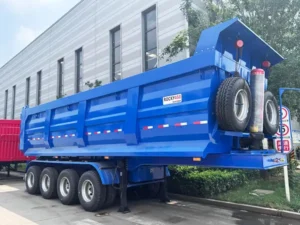
35CBM Tipper Semi Trailer Shipped To Uganda
INTAI Trailer has completed the production and shipment preparation of a 35CBM Tipper Semi Trailer for a customer in Uganda.


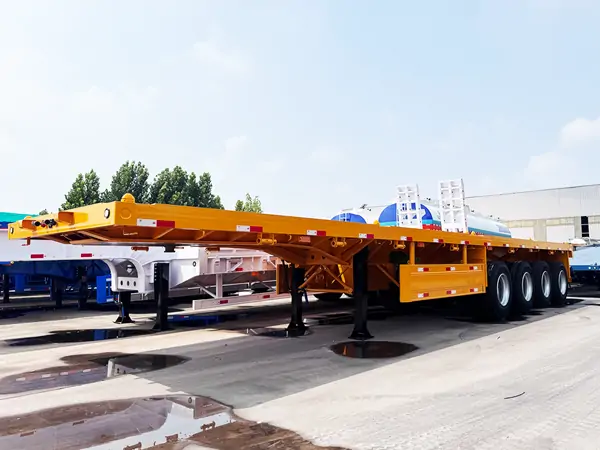
40 foot flatbed trailers play a central role in logistics and transportation, especially in the container shipping sector. Understanding flatbed trailers is highly beneficial for enhancing technical capabilities and improving transportation efficiency. This article will explore the key characteristics of 40 foot flatbed trailers: size, weight, and applications. After reading this article, you will have a clear understanding of how 40 foot flatbed trailers work, the advantages they bring to container shipping, and why they are indispensable, especially in today’s rapidly developing foreign trade industry.

The 40 foot flatbed trailer is a semi-trailer specifically designed for transporting 40-foot containers. Its dimensions can be customized according to the size of the transported containers, such as 20 feet, 45 feet, 48 feet, and 53 feet. Therefore, the flatbed trailer is the ideal choice for container transportation.
1. Standard container (ISO Containers) transport is the core application of flatbed trailer design.By designing container lock positions, a 40-foot flatbed trailer can transport two 20-foot containers or one 40-foot container.
2. Flatbed trailers are also used in the construction industry and agriculture to transport steel, timber, cement, fertilizer, etc.
3. Flatbed trailers can also be used to transport heavy equipment, such as mini excavators, loaders, CNC machine tools, and other machinery.

The standard size of a 40 foot flatbed trailer is 12500x2550x1500 mm. This size meets the needs of 80% of container shipping in the market. Of course, for example, the flatbed size in Saudi Arabia is 13600x2550x1500 mm. Different countries may have slightly different size requirements for flatbed trailers.
The weight of a flatbed trailer depends primarily on its manufacturing materials and structural configuration.
INTAI Trailer has completed the production and shipment preparation of a 35CBM Tipper Semi Trailer for a customer in Uganda.
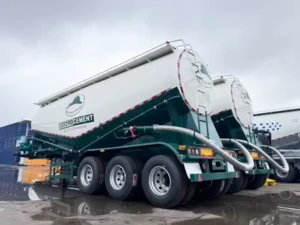
INTAI Trailer has successfully completed the production and delivery of 3 Axle Cement Bulker Trailers, which is prepared for shipment
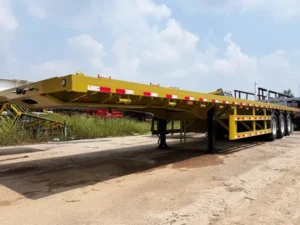
INTAI Trailer recently completed the production and delivery of 3 Axle Flatbed Semi Trailers Shipped To Rwanda, providing a reliable transportation