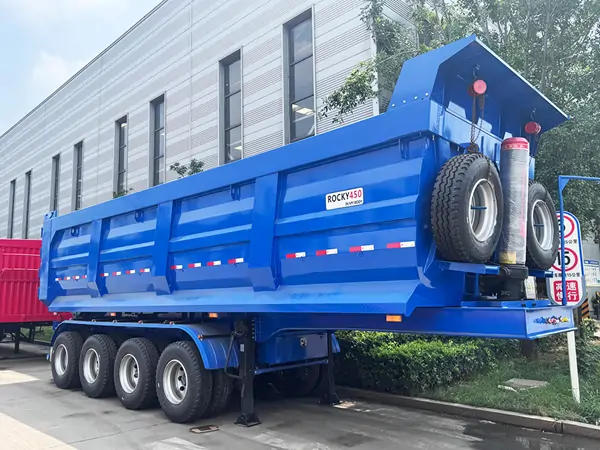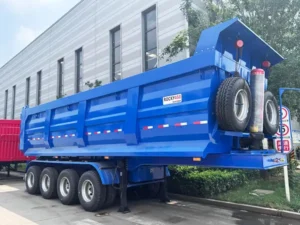
35CBM Tipper Semi Trailer Shipped To Uganda
INTAI Trailer has completed the production and shipment preparation of a 35CBM Tipper Semi Trailer for a customer in Uganda.


Asphalt, as a binder in road construction and an important raw material for petroleum extraction, is an indispensable raw material in today’s industrial context. Because asphalt solidifies at room temperature, its transportation is relatively cumbersome. Therefore, the emergence of asphalt tank trailers has greatly improved the efficiency of asphalt transportation. This article will introduce how bitumen tank trailers smoothly transport asphalt while maintaining its temperature and fluidity.
An asphalt tank trailer is a special type of tank semi trailer designed for transporting high-viscosity goods such as hot liquid asphalt, emulsified asphalt, or coal tar. Because asphalt solidifies rapidly and loses its fluidity at room temperature, the asphalt tank trailer is designed primarily around insulation and heating to prevent the asphalt from solidifying at room temperature; its structure is more like a sealed heating furnace.
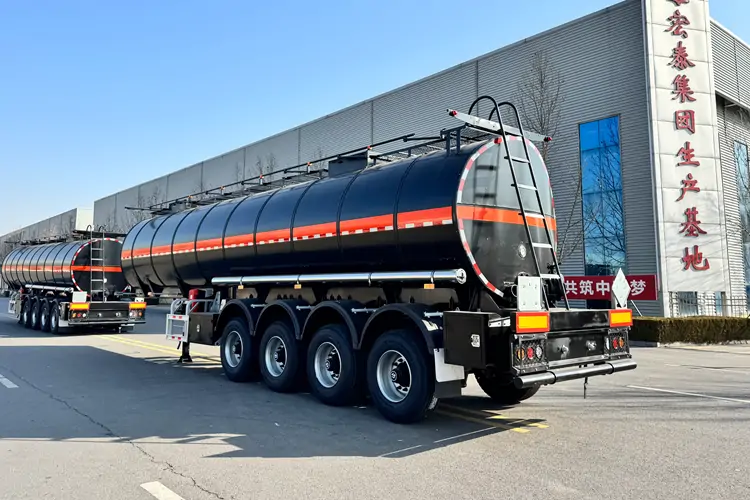
Asphalt tanker trailers have a more complex structure than ordinary tank trucks, typically employing a three-layer protective structure:
1.Inner Tank: The innermost tank layer is in direct contact with the asphalt and is usually made of 5mm-6mm high-strength steel. Their shapes are mostly elliptical or cylindrical, in order to lower the center of gravity and distribute pressure evenly.
2.Insulation layer: Wrapped around the outside of the inner tank, typically 80mm-120mm thick. Commonly used materials include rock wool, glass wool, or polyurethane foam, whose main function is to insulate and reduce heat loss.
3.Outer Shell: The outermost layer is covered by stainless steel or color-coated steel sheets, and its main functions are to waterproof, dustproof, and protect the insulation layer from damage.
A. Fuel Oil Fire Tube Heating System
Working Principle: The burner injects flames into the fire tube located at the bottom of the tank. The high-temperature flue gas circulates within the tube, transferring heat to the asphalt through the metal tube wall.
Features: Rapid heating and relatively low cost. However, strict monitoring is required during operation to prevent localized asphalt from coking and carbonizing due to excessive heating.
B. Steam Heating
Working Principle: Steam heating does not involve directly injecting steam into the asphalt. Instead, it involves circulating heat through metal pipes inside the tank, which then transfer heat to the asphalt.
Steam Inlet: The tank is equipped with a standard quick-connect fitting for connecting to the plant’s steam pipeline.
Heating Coils: The tank is filled with coils made of seamless steel or stainless steel tubing (usually arranged in an “S” shape or in parallel).
Significant Advantages of Steam Heating
1.Extremely Uniform Heating: The gentle heat transfer of steam through the internal metal pipes effectively avoids the “coking” or “carbonization” of the asphalt caused by localized high temperatures.
2.Extremely high safety: It produces no open flame and is the only permitted heating method in explosion-proof areas (such as the core area of an oil refinery).
3.Cost-effectiveness: For factories with waste heat steam, this heating method is almost “zero cost”.
C. Heat transfer oil circulation heating system
This method is commonly found in high-quality modified asphalt transport vehicles.
Core components: independent diesel furnace, heat transfer oil circulation pump, and heat transfer oil pipes on the inner tank wall.
Working principle: First, heat transfer oil is heated, and then the hot oil is circulated into the coils inside or outside the tank by a pump.
Features: Extremely uniform heating, no localized overheating, but the system structure is complex and the vehicle is relatively heavy.
D. Electric Heating System
Core Components: High-power electric heating element or induction heater, external industrial power supply or vehicle battery.
Features: Zero emissions, precise temperature control. Often used in temporary storage vehicles on fixed routes or at docks and mixing plants.
| Asphalt tanker trailer | Regular oil tanker trailer | |
| Insulation layer | Yes | No |
| Heating system | Yes | No |
| Tank material | Most are carbon steel. | Carbon steel/aluminum alloy |
| Weight | Heavier (including the insulation heating system) | Lighter (especially aluminum tanker) |
INTAI Trailer has completed the production and shipment preparation of a 35CBM Tipper Semi Trailer for a customer in Uganda.
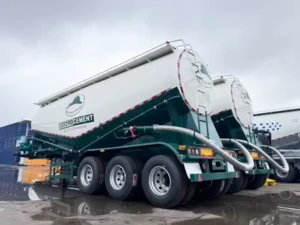
INTAI Trailer has successfully completed the production and delivery of 3 Axle Cement Bulker Trailers, which is prepared for shipment
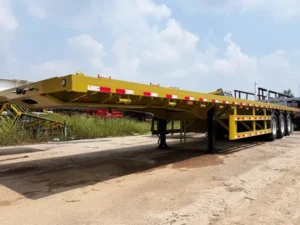
INTAI Trailer recently completed the production and delivery of 3 Axle Flatbed Semi Trailers Shipped To Rwanda, providing a reliable transportation