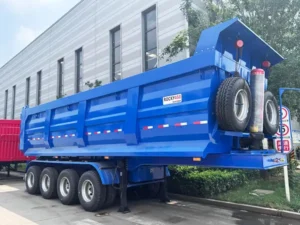
35CBM Tipper Semi Trailer Shipped To Uganda
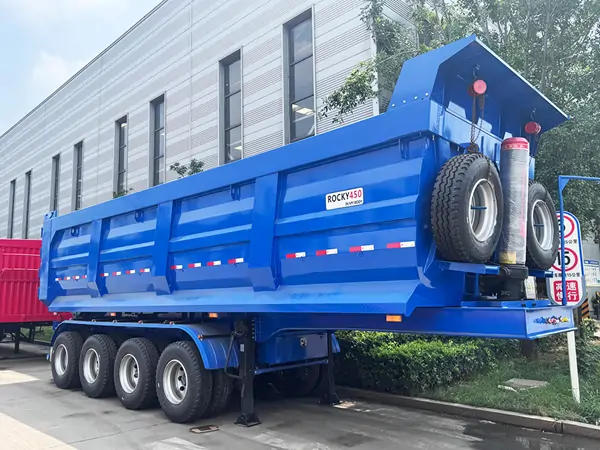
INTAI Trailer has completed the production and shipment preparation of a 35CBM Tipper Semi Trailer for a customer in Uganda.


The air compressor is considered the “heart” of the bulk cement trailer unloading system. Its main function is to compress air and input it into the tank, thereby fluidizing powders such as cement, lime, and fly ash inside the tank and transporting the powder to the target storage location through pressure difference. The following is a detailed introduction from three dimensions: working principle, core functions, and main structure:
1. Power Input Stage
The air compressor of a cement trailer is not powered by itself; it requires external drive. Power comes from the tractor’s engine or diesel engine to power the air compressor. Typically, powder tanker trailers are equipped with a small-power diesel engine, usually a twin-cylinder or four-cylinder unit. This method does not rely on a tractor and offers greater flexibility in application scenarios.
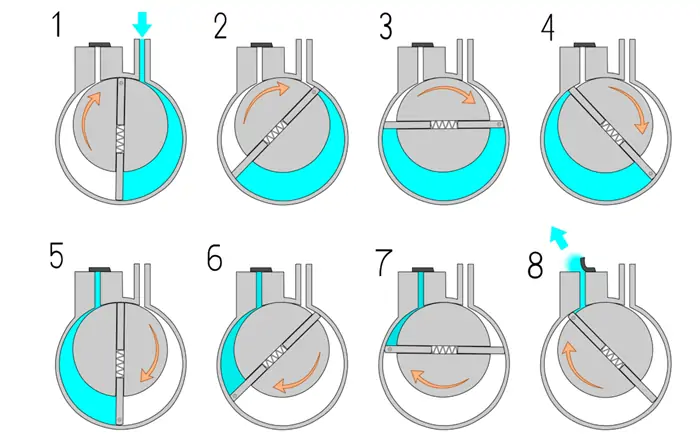
2. Air Compressor Compression and Exhaust Process
The most commonly used air compressors in powder tank trucks are cycloidal rotor or vane type air compressors.
Intake: As the rotor rotates inside the eccentric cylinder, the volume on the intake side gradually increases, generating a vacuum suction force that draws in outside air through the filter.
Compression: As the rotor continues to rotate, the volume of this space continuously decreases. According to Boyle’s Law, a decrease in volume will cause a rapid increase in air pressure.
Exhaust: When the pressure reaches the predetermined exhaust pressure (usually around 0.2 MPa), the exhaust valve opens, and compressed air enters the air delivery pipeline.
In the operation of cement trailers, the power of the air compressor directly affects unloading efficiency, cost, and system lifespan. The following are the key impacts of air compressors with different power (displacement) on the operation of bulk cement silo trailers:
1. Unloading speed and operational efficiency: The power of the air compressor directly determines the total amount of compressed air produced per unit time.
Advantages of high-power (e.g., 12-14 m³/min) air compressors: They can rapidly increase tank pressure, shortening pre-compression time. Material fluidization is more complete, and unloading speeds can reach over 1.5 tons/minute, resulting in higher unloading efficiency and reduced transportation costs.
2. Conveying Height and Distance (Pressure Stability)
The power of the air compressor directly affects its ability to overcome gravity.
High-power air compressors: Provide more stable airflow support, maintaining a balanced powder-to-air ratio in the pipeline when facing tall silos (over 20 meters) or long-distance horizontal conveying, preventing powder from settling midway. Insufficient power may lead to insufficient power reserve and the risk of pipeline blockage.
3. Residual Material Rate
The residual material rate is a key indicator for evaluating the performance of a powder tanker truck. A well-functioning air compressor has a strong airflow, which can effectively reduce the residual material rate on the tank walls and in dead corners. Generally, a residual material rate controlled within 0.3% is considered acceptable.
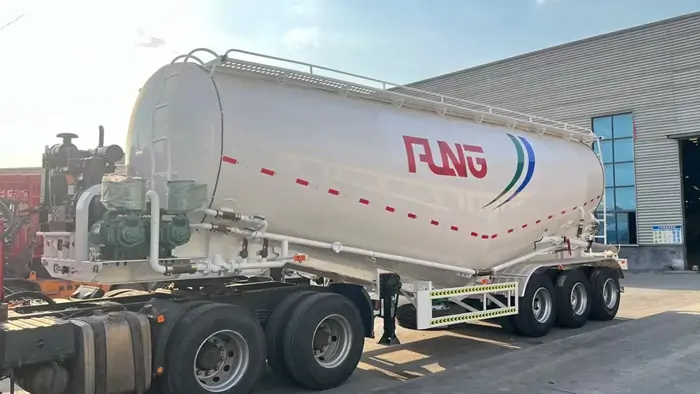
In summary: Simply put, the working principle of an air compressor is: intake air → reduce volume and increase pressure → inject into the bottom of the tank to “fluidize” the powder → use the pressure difference to expel the powder from the tank.
INTAI Trailer has completed the production and shipment preparation of a 35CBM Tipper Semi Trailer for a customer in Uganda.
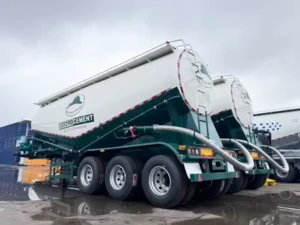
INTAI Trailer has successfully completed the production and delivery of 3 Axle Cement Bulker Trailers, which is prepared for shipment
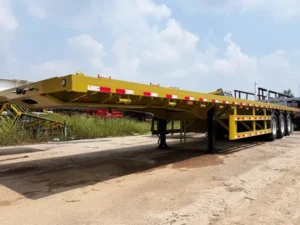
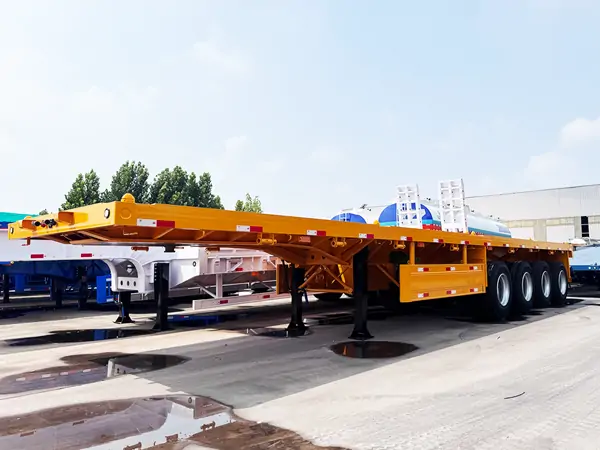
INTAI Trailer recently completed the production and delivery of 3 Axle Flatbed Semi Trailers Shipped To Rwanda, providing a reliable transportation