A Comprehensive Guide to Pneumatic Trailers: This article will introduce pneumatic trailers from the aspects of principles, types, applications, and maintenance.
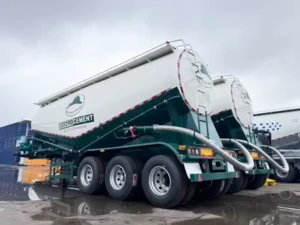
A pneumatic trailer is a specialized semi trailer equipped with a sealed pressure tank for transporting bulk dry, fine-grained materials such as cement, lime powder, and mineral powder. It uses compressed air to increase the pressure inside the tank, fluidizing the powdery materials inside, and then uses pipelines for efficient and dust-free loading and unloading operations.
二、What types of pneumatic trailers are there?
Pneumatic trailers are classified by shape into V-type, W-type, horizontal, and vertical types, and by design material into carbon steel, stainless steel, and aluminum alloy.
V-type and W-type pneumatic trailers are the most common types of bulk powder transport trailers, typically designed with a capacity of 20m³-60m³. If customers require a larger capacity pneumatic trailer, engineers will usually adopt a horizontal design and divide it into 2-3 compartments to ensure tank strength and transport safety.
Carbon steel pneumatic trailers are the most common transport mediums for bulk cement, mineral powder, fly ash, etc. If the transport medium is food such as flour, milk powder, or feed, stainless steel pneumatic trailers or food-grade aluminum alloy pneumatic trailers are usually used, and the materials used must meet national food safety standards.
三、Application of pneumatic trailers
Pneumatic trailers, with their advantages of being environmentally friendly, efficient, and versatile, have become an important solution for engineering construction, industry, mining, and bulk powder transportation.
Perform maintenance and inspection on the air compressor, clean the air filter, and check the belt tension.
Power System: Inspect and maintain the air compressor and diesel engine; replace the air compressor oil and oil filter.
Air System: Check the pipes for aging using a pressure gauge and leak detector; disassemble the main valve and butterfly valve and clean their internal parts.
Tank Maintenance: Regularly inspect the inside of the tank for cracks; grind and spray any damaged areas with anti-rust primer and topcoat.
五、Precautions for using pneumatic trailers
1.Before the loading and unloading operation begins:
Check the air pressure system to ensure the tank pressure is normal.
Check the air compressor oil level; the oil level should be in the middle position of the sight glass.
Test the pressure gauge to ensure it is at zero/normal.
Check all air pipe joints for any obvious air leaks.
Check that the manhole cover of the tank is sealed tightly, that the bolts connecting the unloading pipe are tightened, and that the tire pressure, suspension system, and outriggers are in normal condition.
2.After loading and unloading, an inspection is required.
After confirming that all valves are closed, open the vent valve to completely release pressure. Disassembling any pipelines or components under pressure is strictly prohibited.
Purge or clean any remaining material in the unloading pipe.
The Impact of Pneumatic Trailers
Pneumatic trailers, also known as pneumatic conveying tank semi-trailers for bulk materials, revolutionize the traditional “solid” transport of goods. Their core innovation lies in the “flow of bulk materials.” The tank is not simply a container, but a precisely designed low-pressure chamber. Special air bags at the bottom of the tank, under the action of compressed air, instantly impart fluid properties to the powdery materials, allowing them to flow smoothly into the pipeline.
This technology solves three major long-standing problems in bulk material transportation: dust pollution, unloading efficiency, and space constraints. It marks the beginning of a closed, efficient, and automated era of “transportation” in bulk logistics.