Semi-trailers, as an important component of logistics transportation, lack their own power and require a tractor unit to provide power for normal operation; the two are interdependent. This article will delve into the differences between semi trailers and trucks, and introduce the functions of various types of semi trailers.
The difference Between a Truck and a semi Truck Trailer
1.The fundamental difference in structure
The most direct difference between a truck and a semi-trailer is that a truck is a single unit; while a semi-trailer consists of a tractor unit and a semi-trailer unit connected by a towing pin. A semi-trailer can be separated by disconnecting the towing pin and the saddle, while a truck cannot.
2.The difference in weighing
Trucks: All weight is borne by their own chassis, and their load-bearing capacity is limited, making them suitable for short-distance transportation.
Semi trailer trucks: The weight is composed of two parts: the semi-trailer’s load-bearing portion and the tractor’s load-bearing portion. Furthermore, the semi-trailer’s load-bearing capacity can vary depending on the number of axles, making its load-bearing capacity its most prominent advantage, suitable for long-distance transportation of bulk goods.
3.Control and flexibility
Turning radius: The longer the truck chassis, the more difficult it is to turn. Although semi-trailers are longer, because they have a connection point at the tractor unit, their turning radius may actually be smaller than that of a single-unit vehicle of the same length, making them more maneuverable.
Reversing difficulty: When reversing a semi-trailer, you need to “turn the steering wheel in the opposite direction”, which is much more difficult than reversing a single truck and requires a high level of skill from the driver.
4.The differences in transportation modes
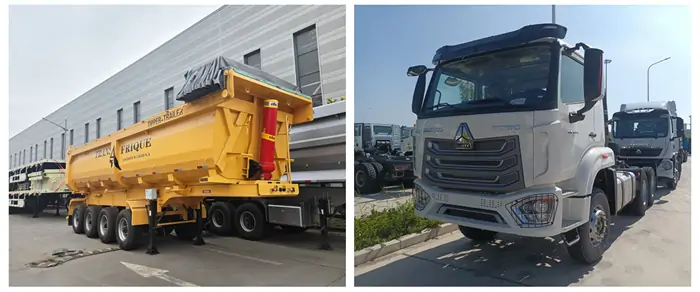
One of the biggest differences between semi-trailers and trucks is that semi-trailer trucks can detach from their trailers after being fully loaded and arriving at their destination. The tractor unit can then link with other trailers to continue its journey, which can significantly improve transportation efficiency in certain situations.
Functionality: As long as the tractor unit has a uniform saddle height, it can tow various types of semi-trailers, while trucks cannot achieve this.
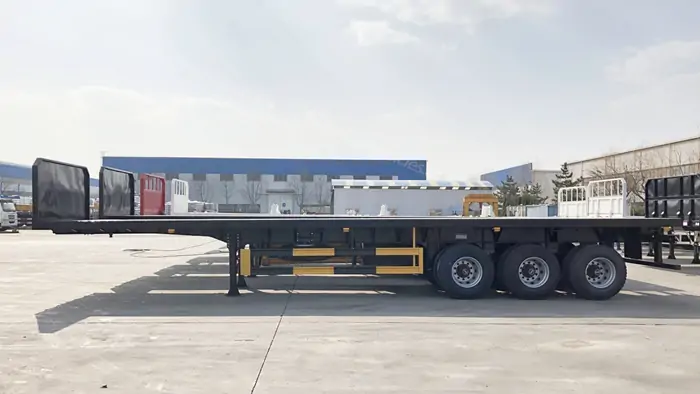
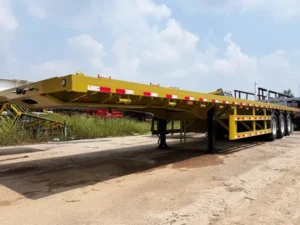
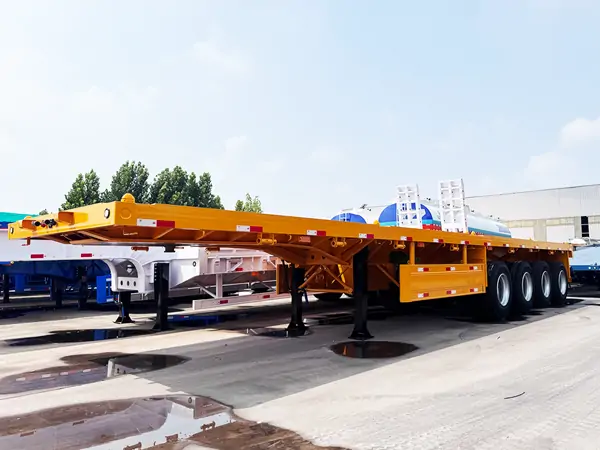
Flatbed trailers are the most common type of semi-trailer used in global road transport. Their flat cargo surface offers exceptional loading and transport flexibility, allowing them to transport not only containers and machinery but also bulk cargo and building materials. Flatbed trailer dimensions are typically designed to match container sizes, with 20-foot and 40-foot flatbed trailers being the most common, and 45-foot trailers also frequently seen in the Americas market.
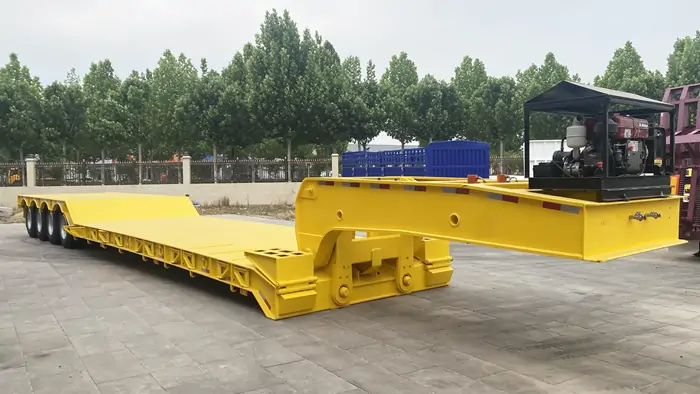
A lowbed trailer is a semi trailer specifically designed for transporting heavy machinery. Unlike flatbed trailers, low bed semi trailers have a lower cargo surface and are equipped with a ladder at the rear for easier loading and unloading of construction machinery. Low-flat trailers are classified into three types according to the size and weight of the transported goods: gooseneck low-flat trailers, detachable gooseneck low-flat trailers, and extendable lowbedt trailers.
Lowbed Trailer: As the most common type of lowbed trailer, the ordinary gooseneck lowbed semi trailer is usually used to transport 40-70 ton machinery and equipment. Its ladder is located at the rear of the semi-trailer. This type of low bed trailer is widely used in Africa and Asia.
Detachable Gooseneck Trailer: The movable gooseneck trailer (RGN trailer) is a special type of lowboy trailer. Its gooseneck can be lifted and detached via a hydraulic system. The movable gooseneck lowbed has two small ramps for loading and unloading machinery, and is often used to transport oversized and overheight equipment.
Advantages: Lower loading surface, lower center of gravity, and higher safety.
Extendable Lowbed Trailer: This type of semi-trailer can increase the cargo surface length by extending the main beam. It is mainly used to transport extra-long goods, such as wind turbine blades, steel pipes, and other extra-long equipment.
Advantages: The length of the extended cargo surface can be flexibly selected.
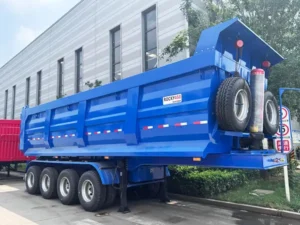
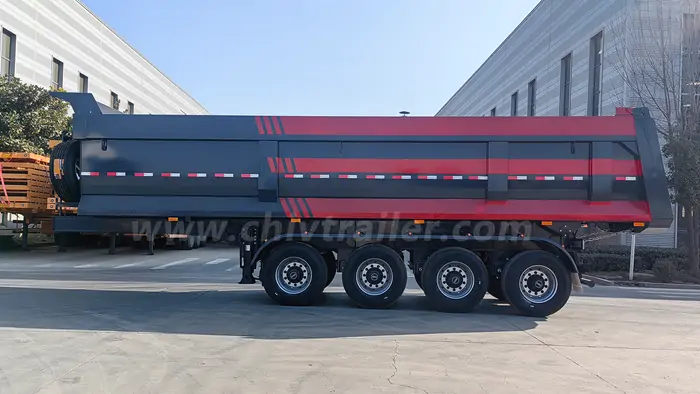
Dump trailers are semi trailers mainly used for transporting bulk goods such as sand, stones, ores, and building materials. Their working principle primarily involves using a hydraulic system to lift and unload the cargo box. They are widely used in infrastructure projects such as engineering construction and mining areas. Dump trailers are divided into end dump trailers and side tipper trailers, the main difference being the direction of unloading.
End Dump Trailer:Rear dump trailers are among the most widely used semi-trailers for transporting sand and gravel globally. Their hydraulic system is located at the front of the semi-trailer, lifting the cargo to tilt from the rear.
Advantages: Fast unloading speed, simple operation.
Side Tipper Trailers: Side tipper trailers, as the name suggests, unload cargo from the side. Their hydraulic system is located under the cargo box, unlike rear-tipping semi-trailers. Side-tipping semi-trailers have multiple hydraulic cylinders that lift one side of the cargo box to achieve unloading.
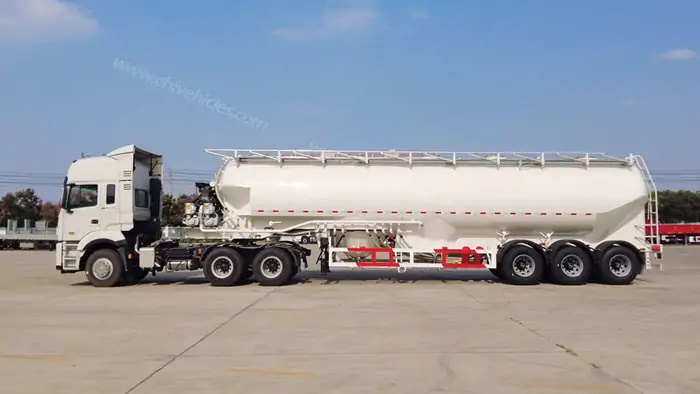
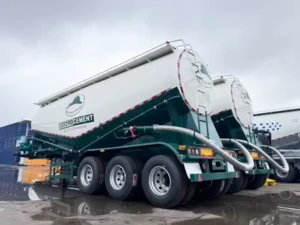
Bulk cement trailers, also known as pneumatic trailers or bulk powder trailers, are mainly used to transport dry powders with a diameter of less than 0.1 mm, such as lime, dry cement powder, fly ash, mineral powder, and flour. The key difference between pneumatic trailers and other tank trucks is that cement trailers utilize pneumatic conveying principles, fluidizing the powdery materials by compressing air before unloading. Compared to traditional bagged cement transportation, bulk cement trailers transport goods in a closed environment, reducing environmental pollution, and are more efficient and labor-saving.There are three most common styles of powder tank trailers: V-shaped, W-shaped, and horizontal.
V-shaped powder tanker: This is the most common structure, with the bottom of the tank in a V-shape. Design features: It has only one or two discharge ports and a low center of gravity.
Advantages: Simple structure; due to the steep slope, materials are more easily concentrated at the discharge port under gravity, resulting in fast unloading speed and low residue rate.
The bottom of the W-type powder tanker is composed of multiple V-shapes, resembling a W.
Design Features: Typically features multiple compartments and discharge ports, resulting in extremely high internal volume utilization.
Advantages: Within the same overall vehicle length, the W-type design offers greater volume.
Application: Suitable for high-capacity transportation needs. Application: Suitable for high-capacity transportation needs.
Horizontal vs. Vertical/Tipper: Horizontal: The most mainstream, relying on an internal fluidized bed for unloading.
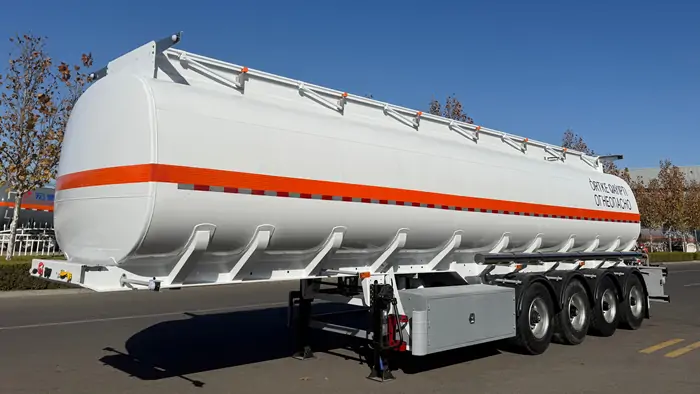
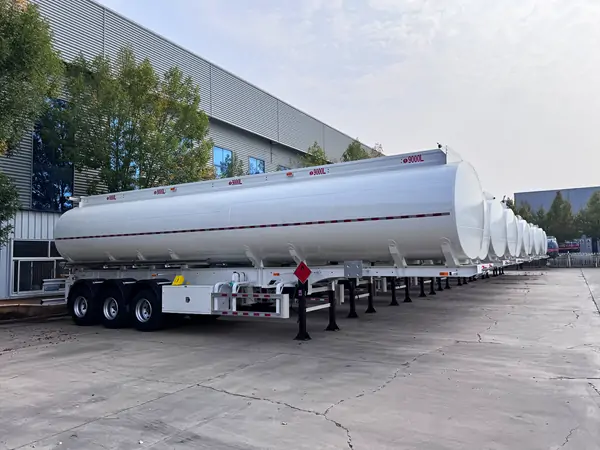
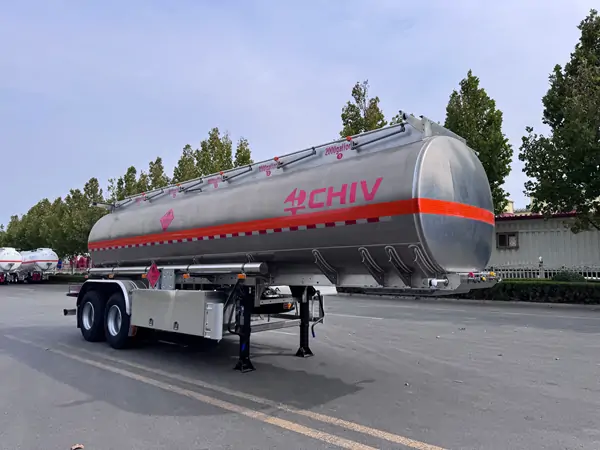
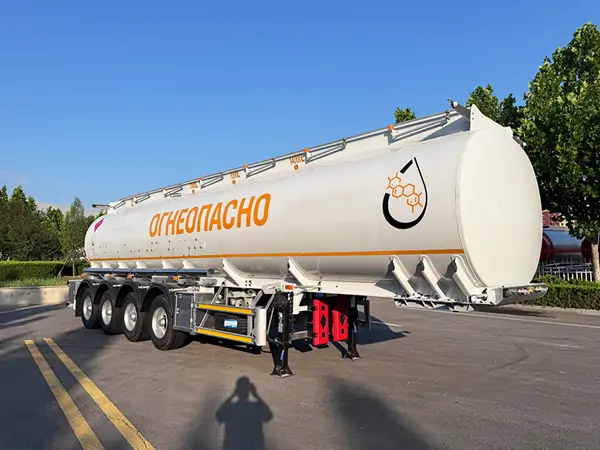
As a core transportation tool for fuel transportation, oil tanker trailers can be used to transport various fuels such as gasoline, diesel, jet fuel, and crude oil. Their materials can be divided into three types: aluminum alloy tanker, carbon steel tanker, and stainless steel tanker.
Aluminum fuel tanker trailers: As a primary vehicle type for lightweight transportation, aluminum alloy fuel tank trailers are lightweight, allowing for the transport of more fuel within weight limits, thus significantly improving transportation efficiency.Aluminum alloy oil tanks are designed for excellent corrosion resistance. This is because aluminum reacts with air to form an oxide aluminum protective film, which isolates aluminum from contact with air. Aluminum tanker trailer are suitable for transportation in humid and coastal cities.
Steel oil tank trailers: Carbon steel tank trailers are stronger and can withstand external impacts; they are not easily deformed and are very suitable for complex and bumpy road conditions.
Stainless steel tank trailers: Stainless steel tank trailers are typically used to transport liquids such as vegetable oil, palm oil, edible oil, ethanol, and fresh water. They have excellent corrosion resistance; and their smooth surface makes it easier to ensure the ultimate cleanliness of the liquids.
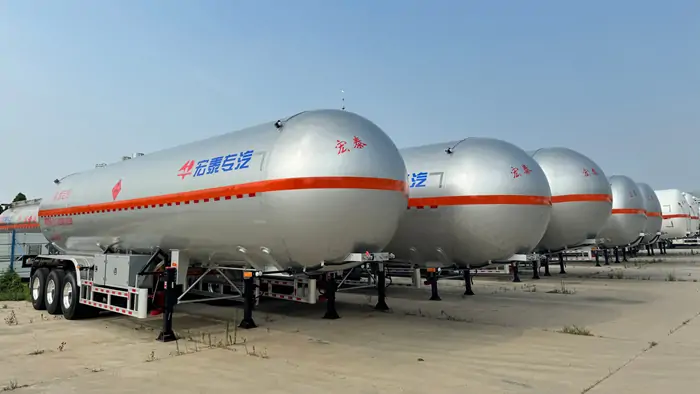
LPG tank semi-trailers are specifically designed for transporting liquefied petroleum gas (propane, butane, and mixtures thereof). Compared to ordinary oil tankers, LPG tankers are special pressure vessel transport equipment with extremely high design, manufacturing, and safety standards. Unlike ordinary tanker trailers, LPG is typically designed with a pressure between 1.61 MPa and 1.77 MPa, and the test pressure (water pressure test) is even higher.