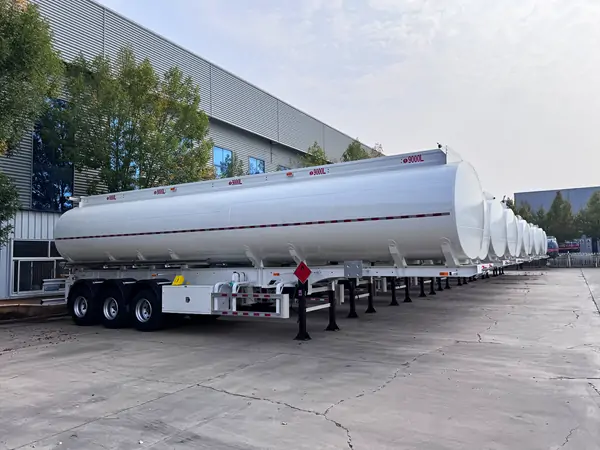



What is a container trailer?
As the name implies, a container trailer is a type of semi-trailer specifically designed for transporting shipping containers. By incorporating specialized container locks on its chassis frame, the trailer securely fastens the container to the chassis, thereby ensuring the safety of the cargo during high-speed travel or over rough terrain. It is also capable of transporting ISO tank containers. Its primary application lies in facilitating the efficient and seamless integration of “multimodal transport” between ports, freight yards, and warehousing centers.
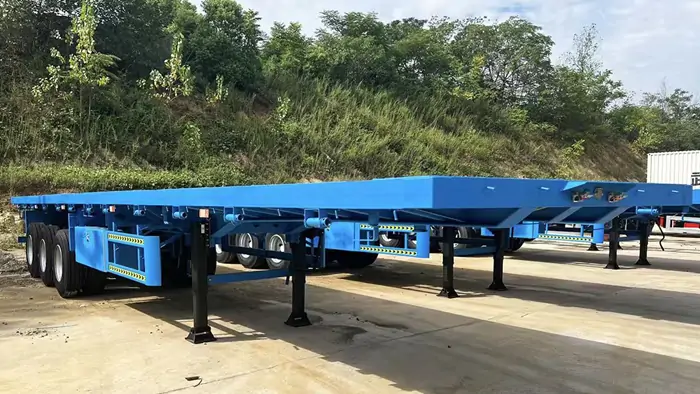
Flatbed trailers are also referred to as container trailers; a shared feature with skeletal trailers is the inclusion of container twist locks. The key difference lies in the fact that flatbed trailers possess a flat, solid deck. In addition to transporting containers, they can also carry other types of bulk cargo, offering a wider range of applications compared to skeletal trailers—though their cost is typically higher than that of skeletal trailers.
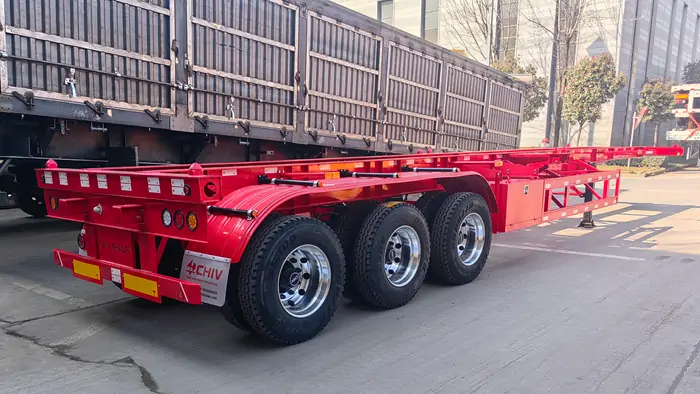
What kinds of goods can be transported by the chassis trailer?
- Standard ISO Containers: Capable of flexibly carrying standard 20-foot, 40-foot, or 45-foot dry cargo containers. By adjusting the position of the twist locks, a single 40-foot skeletal trailer can typically transport two 20-foot containers simultaneously or one 40-foot container.
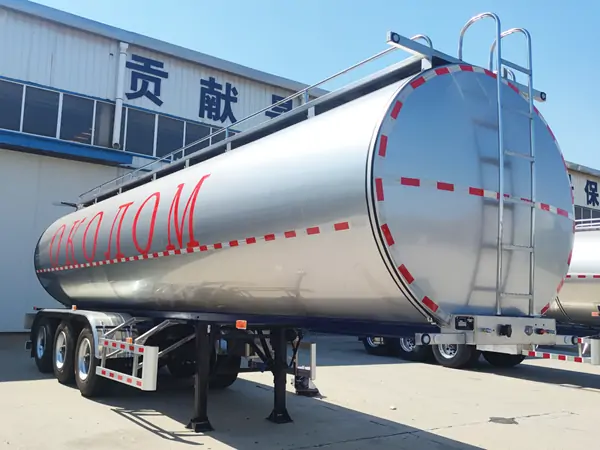
- ISO Tank Containers (ISO Tanks): This represents a critical application for skeletal trailers within the energy and chemical industries. They are utilized to transport tank containers holding chemical liquids, liquefied gases, or bulk food products (such as alcohol or vegetable oils). This type of transport places extremely high demands on the chassis’s center-of-gravity stability.
- Refrigerated Containers (Reefers): Used for transporting cold-chain cargo (such as frozen meat, vegetables, and fruit). Skeletal trailers can typically be optionally equipped with a generator set (Genset)—either front-mounted or chassis-mounted—to provide a continuous power supply to the refrigerated container.
- Special material containers: These include bulk cement tanks for construction sites, special ore containers for mining areas, and chemical tanks for chemical industries. All of these can be transported by container trailers; they have a wide range of applications.
Understand the dimensions of container chassis trailers
In the container shipping industry, the dimensions of chassis trailers are usually designed strictly according to the dimensions of ISO international standard containers to ensure universality and interchangeability in global logistics.
Depending on different transportation needs and regional regulations, container trailers (especially skeleton trailers) mainly come in the following mainstream specifications:
1. 20-foot container trailer
This is the most basic specification, specifically designed for transporting a single 20-foot standard container.
Design Features: Features a shorter chassis frame and typically utilizes a 2-axle or 3-axle configuration.
Applications: Ideal for transporting cargo that is heavy in weight but compact in volume (such as construction materials, steel products, or small machinery); primarily utilized for short-haul transfers within port areas.
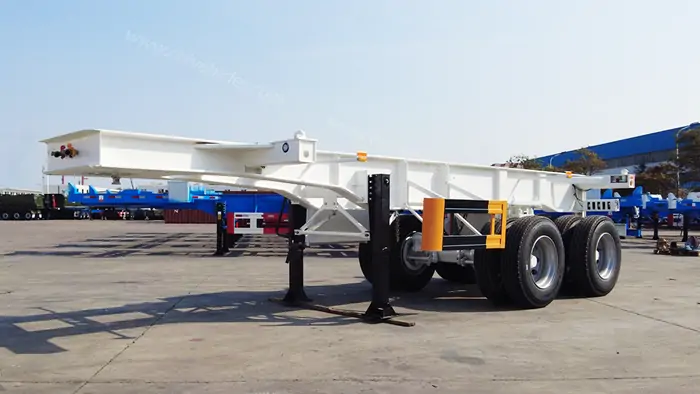
2. 40-Foot Container Trailer (40ft Container Trailer)
This is currently the most widely used specification in global logistics.
Versatility: Trailers of this specification are typically designed with a flexible twist-lock layout, allowing them to transport either a single 40-foot container or—by adjusting the lock positions—two 20-foot containers simultaneously.
Standard dimensions: The length is typically about 12.4 meters (40 feet), and the width is about 2.5 meters.
3. 45-Foot Container Trailer (45ft Container Trailer)
With the increasing prevalence of 45-foot “High Cube” containers in maritime shipping, this extended-length trailer variant has become increasingly common.
Design Features: Features a chassis frame that is longer than that of a 40-foot trailer; the rear section often incorporates a telescopic or extendable design to properly support the 45-foot container body.
Advantages: Offers greater cargo volume capacity, making it suitable for transporting lightweight, voluminous cargo.
4. Specialized and Combination Specifications
In addition to the standard lengths mentioned above, there are various variants designed to meet specific requirements:
20/40-Foot Universal Trailer: Achieves perfect compatibility with both 20-foot and 40-foot containers through the use of retractable or removable twist-locks positioned along the central section of the chassis frame. Gooseneck Trailer: Specifically designed for transporting High Cube (HC) containers; it ensures that the vehicle’s overall height complies with traffic clearance limits by lowering the loading surface.
Extendable Skeletal Trailer: The length of the trailer frame can be adjusted—extended or retracted—to accommodate various container sizes (20ft, 40ft, 45ft).
What are the different types of container trailers?
Based on structural design and application scenarios, container trailers are primarily classified into the following three major categories:
1. Skeleton Container Trailer (Skeleton Trailer / Chassis)
The skeleton trailer is the most widely used model. It eliminates the superfluous floor decking, retaining only a main beam structure constructed from high-strength steel, thereby pursuing an ultimate lightweight design.
Advantages: Low tare weight and high payload capacity.
Applications: Frequent turnover operations at port container terminals and long-haul logistics.
2. Flatbed Container Trailer (Flatbed Trailer)
Unlike the skeleton trailer, the flatbed trailer features a solid, fully decked platform.
Advantages: It is multifunctional. In addition to transporting standard containers, it can also transport steel, timber, or bagged goods after removing the locks.
Applicable to: Operators who need to handle return freight or also transport general cargo.
3. Gooseneck Container Trailer: The gooseneck design is specifically designed for transporting high cube containers by lowering the height of the loading surface.
Advantages: Lowers the vehicle’s center of gravity, enhances driving stability, and ensures that the vehicle’s overall height complies with traffic regulations.
How to Choose the Right Container Trailer? (Buyer’s Guide)
- Identify the main sources of cargo: If you are only running port transshipment, skeleton trucks are the best ROI (Return on Investment) option.
- Versatile cargo transport: If you need to transport more than just containers, choose a flatbed trailer. It can transport a wider variety of cargo and is easier to match with transport needs.
- Consider road conditions and regulations: In regions such as the Americas or Africa, there are strict restrictions on axle load distribution. You may need to choose a 2-axle, 3-axle, or even 4-axle design according to local laws.